

Last Edit 2026-05-10
Restarting Rehab Progress Stalled at a Plateau
By Allan Gardiner
A new approach to using interactive, variable-wavelength light
Every rehabilitation clinic has clients who are about to or have plateaued: guarding, learned non-use, post-surgical pain, CRPS that resists desensitization, stroke/spinal cord injury clients whose recovery has stalled, chronic pain that has outlasted every protocol.
Across the United States millions of adults live in this category with high-impact chronic pain and functional impairment that no longer responds to conventional care.
This essay presents a different way of looking at these conditions and introduces a set of interactive, light-based methods developed to “restart” stalled healing and a resumption of normal functioning within the constraints of tissue damage.
The central idea is that in many of these difficult cases, the body has accepted a maladaptive “new normal,” has stopped updating key sensorimotor systems, and actively resists conventional attempts to restart progress.
A skilled therapist interactively adjusts three integrated methods based upon observations to efficiently prompt those systems to resume updating.
A unifying upstream problem: failure-to-update
When updating fails, the body behaves as if the original threat, injury, or imbalance is still present, even when circumstances have changed. Sensory and motor “maps” are not refreshed. The result is a stable maladaptive status quo that resists intervention.
The conventional clinical model often treats each syndrome as a separate entity with its own mechanisms and treatment pathways. In contrast, our approach focuses on an upstream unifying factor: failure-to-update sensorimotor systems. Downstream information becomes late, corrupt, or missing that results in signs and symptoms that may no longer be linked to the injury.
Real‑time recordings from PhotoMed Technologies’ feasibility studies show that the body can revert to an earlier functional state upon a restart of updating. Figure 1.
The recordings and data often show an abrupt improvement in function and pain relief marked by a flinch, gasp, deep breath, or spontaneous report of surprise.

Figure 1 Conditions shown in real-time recordings that responded to the integrated interactive set of light-based methods.
Why dynamic signals matter
A key biological principle guides our interactive methods: living systems respond more strongly to dynamic, changing signals than to static ones. Static stimuli are easy for the nervous system to adapt to and ignore; dynamic stimuli demand attention.
However, most conventional light‑based therapies rely on fixed wavelengths and steady outputs. They deliver a single, predetermined band of light and assume that wavelength will be effective across clients and conditions. Figure 2, Laser.

Figure 2 Comparison of the dynamic variation of wavelengths and frequencies from the Varichrome® Pro and a single example wavelength from a laser.
Our methods take the opposite approach. We assume that the needed wavelengths or precise stimulation cannot be known before the methods “work.” Instead, the clinician varies wavelengths from throughout the visible spectrum and frequencies while monitoring physiological responses. (Figure 2)
Observing a response often suggests an endpoint for the session as the body reverts to a normal status quo wherein healing progress can resume. Appropriate pre/post measures document outcomes.
The working model is that:
-
The body is continuously ready to resume healing when it receives an appropriate signal.
-
The body has accepted and actively maintains a “new normal” status quo.
-
The specific wavelengths or combinations required are not known in advance and may differ from case-to-case, session-to-session, and minute-by-minute.
-
By dynamically varying wavelengths across hundreds of combinations per minute, the therapy allows the body to “pay attention” to what it needs and ignore the rest.
-
The stimulation works like an alert for the body to check itself out. The rest is automatic.
PhotoMed Technologies’ Varichrome® Pro light delivery system delivers visible wavelengths without gaps, modulated at different frequencies. Figure 3.
Light may be applied to the skin, the eyes, or both, in interactive sessions where the clinician observes and adjusts based on the client’s real‑time responses.
Figure 3 The Varichrome® Pro variable-wavelength light delivery system.
Interactive variable‑wavelength light: how it works in clinic
The integrated methods are interactive, not protocol‑driven. There is no fixed recipe for settings. Therapy is guided by interacting with the client and observing the client’s movement, sensations, pain, or other signs. The clinician selects from several methods based upon which sensorimotor systems appear stuck.
1. Varichrome® Pro – targeted light with movement.
The client attempts the movement that provokes discomfort and identifies where the skin and body signal “stop.”
Light is then delivered to that site while the movement continues with discomfort, but not pain, until the next spot shows up. Iterate.
Consider for pain, restricted or guarded movement, learned non-use, altered sensation. Other conditions shown in Figure 1 include impaired wound healing and cold hands and feet that are applied regionally rather than to a movement endpoint.
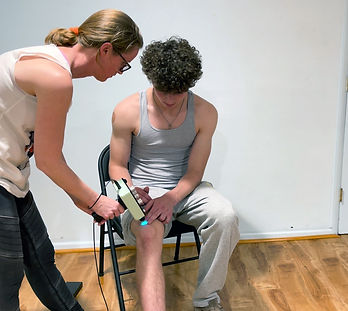
Figure 4 Thomas - Knee pain from sports
2. Varichrome® Relaxation Mask – self-adjusted light to the eyes.
The client or automated settings modulate wavelength and frequency to reach engagement or curiosity. The clinician or assistant interactively guides the client to focus on the light to provide an environment wherein delayed processing of experiences can become ordinary memories. Additional methods aim to improve thoughts-to-speech pathways.
Consider for PTSD intrusions, grief, post-stroke aphasia and apraxia, stuck cognitive or emotional states, movement disorders.

Figure 5 Jeremy - aphasia/apraxia
3. Visual-experience methods (VxM) – no device.
These interactive methods address errors in the expanded sensorimotor systems involved in understanding another person’s actions and intentions. Developed for clients who do not fully respond to the above methods. A flinch, gasp, or deep breath often marks the event when sensorimotor updating resumes to correct the maps.
Consider for phantom pain, post-surgical pain, pain triggered by watching others.

Figure 6 Lois recoils at the instant when her visuospatial maps update and realign. She had a layer of pain in her hand that did not fully respond to the variable-wavelength Method 1.
Positioning alongside conventional rehabilitation
The light-based methods, including the Visual-experience Methods, are not intended to replace established practices. They are adjunctive tools designed to integrate into existing workflows in physical therapy, pain clinics, and rehabilitation medicine.
Who benefits
Clinicians most often consider these methods for clients who are about to or have plateaued on a standard care pathway. A few examples:
-
Post-surgical pain disproportionate to tissue findings
-
CRPS, phantom limb, guarding, learned non-use, and other conditions involving distorted sensorimotor maps
-
Chronic low back, neck, and joint pain that has outlasted a full course of PT
-
Stroke and SCI patients with stalled motor, sensory, or language recovery
-
Non-healing wounds and persistent peripheral circulation problems
Integration into clinic workflow
Clinician: Method 1 is delivered by a licensed PT, OT, or DC or supervised staff. Varichrome® Pro is safety/electrical certified for home use. Method 2 is largely client-directed and runs under supervision from appropriate staff, i.e. SLP for speech improvements. Method 3 (VxM) enhanced with specific clinician training, such as from real-time recordings.
Session, training, and billing: Methods fit inside a standard 45–60-minute session, typically 10 to 15 minutes of light delivery alongside conventional treatment. Clinicians reach initial competency with Methods 1 and 2 through a short training program. VxM requires additional mentored practice. Sessions are documented for therapists’ activities within the existing plan of care and billed under standard therapeutic procedures and neuromuscular re-education codes. The methods and devices do not have separate codes.
Limitations: Structural pathology, active disease, and other medical constraints can prevent a response. The methods are not a universal solution, and non-responding candidates are typically identifiable within the first one to three visits.
Go/no-go within a small number of sessions. Because responses typically appear within seconds to minutes of delivery, clinicians can make clear go/no-go decisions within one to three sessions. The clients are not committing to open-ended trials.
Evidence and participation: the approach rests on 25 years of real-time clinical recordings and multiple U.S. patents covering variable-wavelength, interactive light therapy. Formal outcome characterization is ongoing. Figure 1 identifies maladies having responses that suggest that a failure-to-update flow of information can account for the signs and symptoms that reverted to normal functioning limited by tissue damage.
Reframing chronic conditions
This essay invites clinicians to consider a different narrative for certain chronic, treatment‑resistant conditions.
Rather than viewing pain and impairment as degenerative states or fixed deficits, we can also see them as systems stuck in outdated internal models that the body has accepted as a “new normal.” The flow of information has become delayed, corrupt, or missing.
My engineer’s river model suggests failure-to-update to be like how a dam on a river affects the flow everywhere downstream. Figure 7.
“Chronic” and “new normal” describe the body’s accepted maladaptive status quo.
The problem is that the body actively maintains the status quo by resisting interventions and therapies aimed at downstream effects such as signs and symptoms.
Methods 1, 2, and 3 aim to alert the body to its inhibited flow of information. The rest is automatic.
The methods “work” in combination with conventional methods to keep progress going.

Figure 7 River model: treating downstream signs and symptoms does not address the failure-to-update the flow of information.
Gratitude
Development of the methods was only possible with the participation of people like “Beth” who arrived with hope but little reasonable expectations of improvement. Figure 8.

Figure 8 "Beth" shows how a restart of progress can lead to additional rehabilitation services with the combined methods improving quality of life.
Disclaimer
The Varichrome® Pro and Relaxation Mask are a wellness device system aimed at improving the flow of information and energy within the body. It is not intended to diagnose or treat any disease or disorder.